Originally written in 1943, this remarkable text by Mario Soldati is one of the most lucid and passionate reflections ever devoted to the role of the cinematographer. Last published by the AIC-Associazione Italiana Autori della Fotografia Cinematografica in the 1999 special volume I Cine Operatori, dedicated to the pioneers of Italian cinema and to the founders of the AIC, we republish it today as a tribute to the Association on the 75th anniversary of its foundation—and to those who shaped the very language of film through light.

I had never set foot in a film studio, I had never concerned myself with nor shown any interest in the cinema. Then quite unexpectedly, in July 1931, my family situation obliged me to look for work (…). I was hired by Cines as assistant to Mario Camerini on the film “Ostrega che sbrego. ” I repeat, I had never set foot in a film studio, I had never shown any interest in the cinema. A young man with a surprisingly shrewd and worldly-wise expression, a yellow T-shirt and large spectacles, who appeared to be the perfect secretary to the producer, a lawyer named Besozzi, but who nevertheless showed considerable knowledge of literature and literati, escorted me, showing enormous respect for my humble person, to Studio 2 where he formally introduced me to the “Stage Manager”. (Those were the days, the word “director” had not yet been invented!)
The young man in the yellow T-shirt was Libero Solaroli, and the “Stage Manager” was Mario Camerini: a small, lean, strongman, with a “five o ‘clock shadow, ” who stood very erect. He was formally dressed, in a dark blue suit. He shook my hand vigorously and spoke to me briefly in a grave tone, like the one a captain of a division at the front might adopt with the sublieutenant who has just arrived. (…) While he was speaking to me, I heard another voice ring out authoritatively in the busy silence of the studio: ‘Turn that five thousand! Put it at an angle! Lower, that’s it, good: like that! Now the parabolic. More light!’
The speaker had a strong Piedmont accent. I felt an immediate kinship with that person who had the same accent as I did, and who was giving orders in a loud voice that shattered the silence in the studio. He was a short, very thin and bony middle-aged man, with a pointed noise and chin, and was wearing an odd-looking white hat, similar but not identical to those hats that American sailors wear. Starting with the headgear, his apparel, which included braces, belt and kerchief around his neck, appeared studied, calculated and ordered like a uniform: the uniform of an army of which he was general, officer and soldier rolled into one.
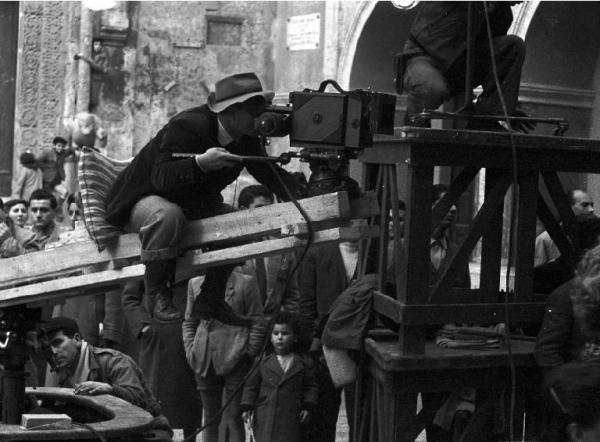
He moved here and there, walking carefully about in the center of the set – a pool-room – giving orders to invisible people above him. I couldn’t work out what he was doing or who he was, and I was so struck by his appearance, so fascinated by his voice, so thrilled to know that he was from my part of the word, I wasn’t aware of anything else: the actors, the scene being rehearsed, the electricians on the bridges above, the camera itself. All his gestures, all his words, seemed to be part of a magic rite; as I continued to stare at him, I didn ‘t even bother to ask who he was, I just remained silent. I said nothing for that entire first day, but just stood there watching and admiring, astonished and dazed, without understanding, without knowing anything, without even wanting to know anything, as I had suddenly, after years of literary and artistic study, been plunged into a technical world to which I had neither given any thought nor even imagined (…).
It was only on the second or third day that I learned that the man (…) was called the cinematographer. I myself gradually learned, without realizing and without really wanting to, the art of filmmaking. But that first impression, which was later modified by my growing experience and my more realistic attitude towards the profession, and replaced with a more precise concept of the cinematographer’s task, never disappeared completely: I instinctively feel, in the very depths of my being – Simono would say in his heart – that the cinematographer was and is the magic, technical core of filmmaking.

But today I ask myself is it really only magic? Does not that first impression of mine, of the importance of technique and of the cinematographer, stem from the actual importance of the photography to the finished film? If we really think about it, how many films have been saved by the photography?! Take “Quai des brumes” itself have you ever asked yourself what it would be without the silvery patina that Schuftan createdfor it? If we consider Italy’s entire production for a moment, from the advent of sound to the present, we realize that it is supported by four pillars, that is, our four great veteran cinematographers, who were our four most skilled cinematographers of the silent era; namely, Montuori, Brizzi, Arata and Terzano.
These four men alone, with their vast experience, their technique, and the refinement of their art through experience, have saved an enormous quantity of films that had been given up on; they kept a float and brought safely to harbor films in danger of sinking; they advised and helped new producers; they instructed, trained and launched all the young directors, kindly pretending to be their pupils and inferiors when they were in fact their teachers and superiors; they collaborated on all the best films; and, amidst companies that sprang up and fizzled out, wheeler-dealers who went bankrupt and made others bankrupt, and opposing and diverse vested interests and speculation, these four greats were mainly responsible for everything that the Italian cinema has produced up until now.
The public is unaware of this, because it is blinded by the artificial glamour of the movie stars – however many tears this may cost or however much blood directors and cinemato- graphers may have to sweat. There are many cases, which are quite well-known, of actresses owing everything to a director. But there are not many cases, and they are far less well-known, of actresses owing everything to a cinematographer. The cursing, the sweating blood, the endless inventions, the endless tricks with gobos, gauzes, jellies, strong light and soft light, strong shadow and soft sha- dow, holes, tubes and grids, sleepless nights while anxiously waiting to see the rushes, muffled arguments in the dark of a small screening room: the cinematographer often has to go through all this, and many other trials and tribulations, for a nose, a movie actress’s nose!

But the aficionados know, and suspect, nothing of this: they think her nose is straight! The good cinematographer often takes pride in the fact that they don’t know, and in concealing his own merit (…). What strikes me most about the cinematographer is that, regardless of the differences in individual characters, there exists a definite type. I think there are very few other professions or crafts that regulate, alter or condition the character of a man to such a degree.
First of all, I noted a number of fixed and unchanging characteristics in all Italian cinematographers. Then I met foreign ones, who were French, Belgian or German: I was amazed to see that they possessed the same characteristics as ours. In all parts of the world, the cinematographer is a man of the people, intelligent, pleasant and active, with a great desire to work hard to earn money; that is, to better his social and financial position. Due to the increasingly rapid growth of the film industry during this century, the cinematographer is a working-class man who in the space of a few years has be- come middle-class.
He is the new middle-class, the last to arrive and, like all parvenus, he is the strongest defender, the fiercest advocate of all the established principles upheld by that class (…). The cinematographer is not cultured, he has not studied at length: he would never have had the time. Concerning opinions on art or photography, his views are inevitably eclectic, academic and traditionalist. Also in this case, he is more preoccupied with his origins and social ambitions than his innate flair for photography, which stems from an acute, instinctive feeling for pictorial beauty.

But all cinematographers have this flair, this instinctive feeling for beauty, which is in no way complemented by studies or experience outside the field of cinematography (…). Therefore the cinematographer’s opinions on photography are rooted in eclecticism, academics, and the bourgeoisie. His aesthetic creed is based on the following basic principles: don’t overdo the effects; don’t go too far; everything that is strong must be softened; everything that is soft must be strengthened (…).
From Mario Camerini I learnt, without realizing it, all there is to know about directing and I owe him everything; but how many little tricks, how much infinite, fob-like patience I learnt from the cinematographer! The film director is as close to the cinematographer as the hunter to his dog, the captain to his chief engineer. The skipper of a cargo boat takes his meals with the chief engineer, just the two of them, in private, and all other officers, above and below deck, are excluded. Similarly, the hunter and his dog are isolated, on the heath or in the woods, in a reserved, extremely personal relationship or one that only they understand. It is the same with the director and the cinematographer who, rather than collaborate, establish an indefinable, impassioned friendship, which is almost like the splitting of a single activity into two.
During shooting, this strange relationship can only be detected by a knowing eye; but in the periods between one film and another, when the director is preparing a movie and the cinematographer is not yet aware of his destiny, anyone can see and appreciate the great warmth with which the cinematographer and the director who will be working together, greet and approach each another. Only a man and a woman who will possibly become lovers, behave in a similar way. Knowing smiles, lingering handshakes, words whispered in an ear, romantic strolls through those very unromantic grounds of film studios, and even some friendly pats (…). It is the cinematographer’s instinctive passion for his craft that often leads him, against his own interests and sometimes unwittingly, to work with one director rather than another.
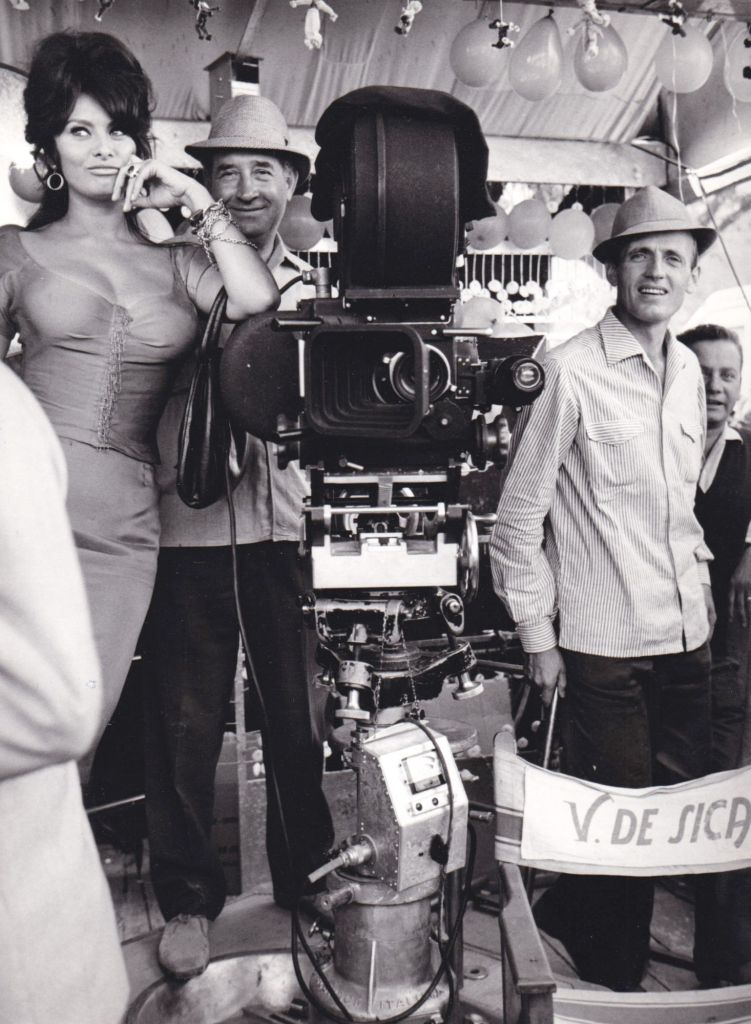
(…) A director who knows more than the cinematographer would make the fatal error of concerning himself more with the photography than the acting, with the inevitable results, since photography is such a difficult, complex and mysterious craft that it alone requires a person’s complete attention. (…) And what if my life were to go backwards instead of forwards, if I were to become less and less involved with film-making and gradually to forget everything I had learned?
(…) The last of so many images to fade would still be that of the first cinematographer I saw, there in the derelict studios in Via Veio, which had not been totally destroyed by Allied bombs. That strange bony individual with a large nose, who was so calm and self-assured, with his white hat, belt and braces, and who flaunted his Piedmont accent with no trace of Roman dialect, as he shouted to the invisible electricians above:
“Turn that five thousand! Lower it! Switch on the parabolic! Open it up! More! More light!”
(Mario Soldati, 1943)
Mario Soldati (1906–1999) was an Italian writer, film director, and one of the pioneers of Italian television. Trained in art history in Turin and Rome, he later studied at Columbia University in New York, an experience that strongly influenced his cultural outlook and narrative style.
From the late 1930s onward, Soldati built a significant career in cinema as a director, screenwriter, and critic. His films are marked by literary sensitivity and psychological depth, with Piccolo mondo antico (1941) and Policarpo (1959) among his most notable works—the latter earning him the Cannes Film Festival Award.
In the 1950s and 1960s, Soldati became a central figure in Italian television, helping to define its cultural identity through innovative documentary and narrative programs that brought literature, travel, and social observation to a mass audience. Alongside his work for the screen, he maintained a highly successful literary career, receiving major awards such as the Strega Prize and the Campiello Prize.
Soldati remains a key figure in 20th-century Italian culture, bridging literature, cinema, and television with a distinctive, humanistic vision.
Scopri di più da TERRE DI CINEMA - International Cinematographers Days
Abbonati per ricevere gli ultimi articoli inviati alla tua e-mail.
