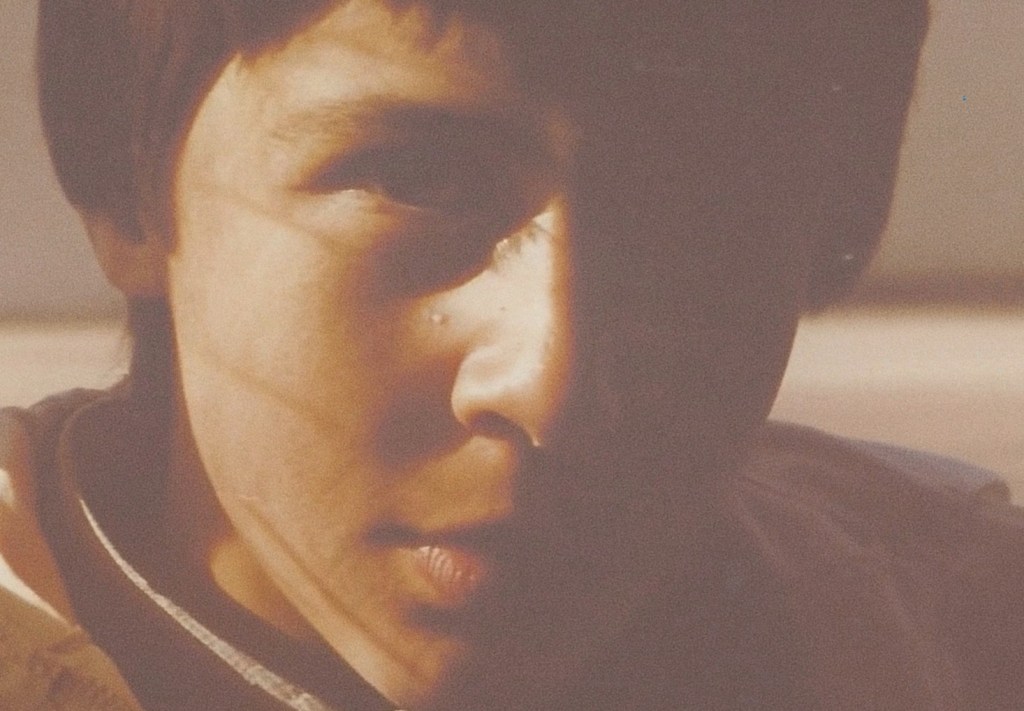
The Italian short film The Most Beautiful Man in the World – L’uomo più bello del mondo, directed by Paolo Baiguera, will be presented in Berlin as part of the Forum Special.
A brief yet powerful work, the film weaves together family memory, archival imagery, and artificial intelligence, exploring questions of representation and remembrance in the digital age.
The project stems from an intimate family story: almost nothing remains of one family member except for 25 photographs of an uncle who died of AIDS. From this fragile visual trace, the filmmaker constructs a two-voiced dialogue. On one side is the mother, who revisits the images through the lens of emotional memory; on the other is an artificial intelligence tool — Google Vision API — which analyzes the same photographs in a purely statistical manner, translating faces, postures, and expressions into data.
25 photographs, a missing life
Q. The film “Most Beautiful Man in the World” starts from a fragile and minimal archive: just 25 photographs of an uncle lost to AIDS in 1980s–90s Italy. How did you approach the ethical and cinematic responsibility of building a film from such a limited, yet emotionally charged, visual trace?
A. As often happens with films like this one, it started as an experiment. I began playing with a website, and then it became clear that I was dealing with something bigger, with greater cultural implications than I had expected at the beginning. As for the limited material, it was certainly a challenge, but the lack of photographs clearly mirrored the lack of information I had about my uncle to begin with, turning that shortage into a
strength rather than a weakness.
Warm memory vs cold vision
Q. One of the most striking elements of the film seems to be the dialogue between your mother’s intimate, emotional memories and the analytical gaze of artificial intelligence. What did this confrontation reveal to you about the nature of memory, and about the illusion of neutrality often attributed to algorithms?
A. Neutrality never exists, and that becomes even more evident when you juxtapose a human voice with an algorithmic one. This is especially true in the case of AI and image analysis, where it becomes quite intuitive to see how the “opinions” of the algorithm are in fact the synthesis of a collective memory and a shared way of thinking.
Images as the last remaining trace
Q. Your film raises a powerful question: what remains of a person when images become the only surviving evidence of a life? In an era dominated by digital archives and automated image analysis, how do you see the role, and the vulnerability, of personal and family memory?
A. I don’t remember where, but I once read a beautiful answer to the question, “What happens when we die?” — “I know that the ones who loved us will miss us.” Even if only a few images of my uncle survived him, the striking pain of his loss is still very present in my family. I would say that images are the only tangible evidence that remains, yet there is a much deeper emotional trace beyond them. Family memory and personal
experience are among the few treasures left to human beings in an era of digital archives, along with our critical thinking. In the invisible lines that connect these two elements lies the role of vulnerability and individual thought in modern society.
Cinema as a space of resistance
Q. Presented in a section of the Berlinale dedicated to experimentation and hybrid forms, the film sits between documentary, visual essay, and artistic research. Do you see cinema, today, as a place where human subjectivity can still resist standardization anddata-driven interpretations of reality?
A. I’m sure of it, and the film itself can probably prove it. It shows how, within the standardization of data-driven interpretation, there lies a powerful tool to understand ourselves collectively. For that to happen, though, you still need a personal perspective on the material you are working with.
From Terre di Cinema to Berlin
Q. You took part in the CineCampus at Terre di Cinema as a space of research and experimentation on images, memory, and authorship. Looking at The Most Beautiful Man in the World now being presented at the Berlinale Forum Special, how do you see the relationship between that formative experience and the film’s journey from an intimate,personal inquiry to an international cinematic context?
A. I deeply treasure the experience at TDC. It allowed me to connect with wonderful filmmakers and cinematographers from all over the world, and in that I can trace a connection between this experience and the international response the work is now receiving.
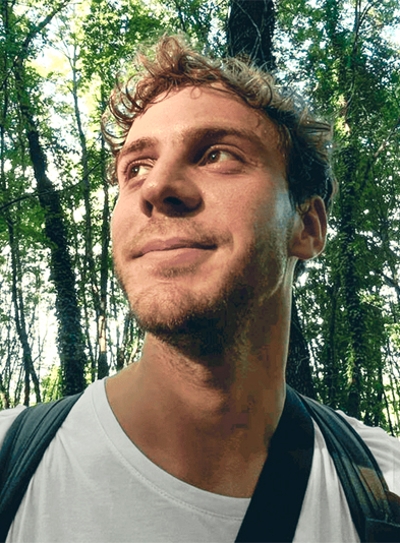
Paolo Baiguera, born 1998, is a director and filmmaker. He has worked on a range of productions with companies including Sky, Rai, Kon-Tiki Film, Indigo Film, ANG Film, and Ring Film. Since 2023, he has been collaborating with Alessio Rigo de Righi and Matteo Zoppis on the feature Testa O Croce? (Heads or Tails?), selected for the Un Certain Regard section at the Cannes Film Festival 2025. His debut short film El pütì pèrs (The Lost Child) premiered at the 2025 Venice International Film Critics’ Week where it received a special mention. He attended the CineCampus of Terre di Cinema 2025 in the Directing Department shooting “La Pillirina” on s16, cinematography by Flaminia Mereu, that is currently in post-production.
Scopri di più da TERRE DI CINEMA - International Cinematographers Days
Abbonati per ricevere gli ultimi articoli inviati alla tua e-mail.
